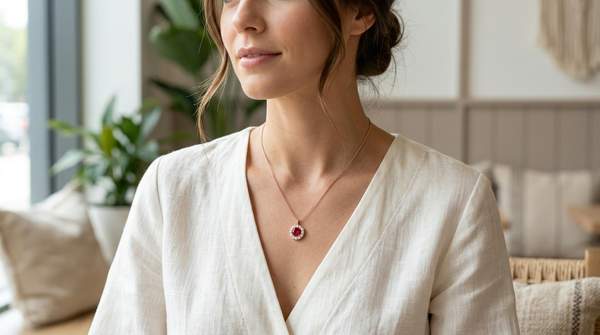
A red ruby surrounded by white diamonds creates a striking centerpiece. Turn that arrangement around, with a white diamond in the middle and blue sapphires circling its edges, and the necklace takes on an entirely different personality.
Ritani offers both interpretations within its lab-grown gemstone jewelry collection. Its ruby halo necklace draws attention to one vivid center stone, while its sapphire design uses alternating blue gemstones and white diamonds to decorate a larger diamond centerpiece. Each presents a different way to bring color into a familiar fine-jewelry style.
A Ruby Center Makes Color the Main Attraction
Ritani’s 0.90 CTW Lab-Grown Ruby with Lab-Grown Diamond Halo Necklace places a 0.65-carat round ruby at the center. Ten smaller round lab-grown diamonds surround it, contributing another 0.25 carat to the design.
The ruby immediately establishes the pendant’s color. Its red appearance becomes the focal point, while the surrounding diamonds create a bright circular frame.
That arrangement gives the necklace a recognizable presence even at a relatively compact scale. The central gemstone supplies a strong color accent, and the smaller diamonds bring additional reflections around its perimeter.
Ritani pairs the ruby with 14kt rose gold, adding a soft pink-toned warmth to the composition. The metal complements the gemstone’s red appearance while providing contrast for the white diamonds.
The pendant hangs from an 18-inch rose-gold chain finished with a spring-ring clasp. Its matching metal creates continuity between the pendant and the necklace, giving the complete piece a coordinated warm-toned appearance.
For someone who loves ruby jewelry, this design places the gemstone exactly where the eye naturally settles. The diamond halo enhances the composition while allowing the ruby to remain its defining feature.
Blue Sapphires Give the Halo Its Own Personality
Ritani’s 1.35 CTW Lab-Grown Sapphire and Lab-Grown Diamond Halo Necklace approaches the same general shape differently. A 1.00-carat round lab-grown diamond occupies the center, surrounded by six blue lab-grown sapphires and six smaller lab-grown diamonds.
Those twelve accent stones alternate around the diamond. The blue sapphires introduce regular points of color, while the smaller diamonds maintain a bright, sparkling sequence between them.
The design creates an intricate border that becomes an attraction in its own right. The larger center diamond provides the principal sparkle, and the surrounding stones form a recognizable blue-and-white pattern.
Ritani specifies 0.20 carat total weight in the six sapphires and 0.15 carat in the six accent diamonds. Combined with the 1.00-carat center stone, they give the necklace its stated 1.35 carat total weight.
The pendant is crafted in 14kt white gold and comes with an 18-inch chain and spring-ring clasp. The cool-toned metal complements the blue sapphires and white diamonds, creating a consistent appearance throughout the piece.
This arrangement can be especially appealing to someone who enjoys classic diamond necklaces but wants a more decorative finish. The diamond remains the centerpiece, with sapphire blue appearing around it in a carefully organized pattern.
The Arrangement Changes What You Notice First
The difference between these two Ritani necklaces becomes apparent before considering their specifications. One creates a red focal point surrounded by white sparkle, while the other places blue accents around a larger white diamond.
The ruby pendant has a clear center-to-edge relationship. Its colored stone dominates the composition, while the diamond halo frames the round outline.
The sapphire pendant creates a different visual rhythm. The alternating accents draw attention around the perimeter, encouraging the eye to follow the sequence of blue sapphires and smaller diamonds.
That changes the effect when the jewelry is worn. The ruby design can read as a vivid red gemstone necklace, while the sapphire version presents itself more prominently as a diamond pendant with colored accents.
Stone count adds another distinction. Ten white diamonds surround the ruby, while the sapphire necklace has twelve halo stones divided evenly between blue and white.
These arrangements give the two pendants their individual appeal. Someone attracted to a prominent colored gemstone may prefer the ruby composition, while another person may enjoy the more intricate border surrounding Ritani’s sapphire-accented diamond.
Rose Gold and White Gold Shape the Overall Palette
Precious metal contributes more than a setting for the gemstones. Its color continues through the chain, creating a relationship between the pendant and the jewelry resting around the neckline.
Ritani’s ruby necklace combines red with 14kt rose gold. The pink-toned metal creates a warm surrounding color, while the diamonds provide bright white accents that distinguish the halo.
The sapphire necklace uses 14kt white gold, giving its blue-and-white gemstones a cooler frame. The metal supports the pendant’s color scheme without introducing a prominent yellow or pink contrast.
Those combinations offer different styling possibilities. A rose-gold ruby pendant can sit beautifully beside small rose-gold earrings or a simple warm-toned bracelet.
The sapphire necklace offers another direction. White-metal diamond studs, a slim white-gold bracelet, or other blue gemstone jewelry can complement its cooler palette.
The same designs can also stand alone. With colored gemstones, diamond accents, and coordinated precious-metal chains, both necklaces contain enough detail to become the principal jewelry feature near the face.
Carat Weight Reveals How Each Necklace Is Built
Ritani’s ruby necklace has a combined gemstone and diamond weight of 0.90 carat, while the sapphire halo necklace totals 1.35 carats. The figures become more interesting when considered alongside the position of the stones.
In the ruby pendant, the 0.65-carat colored center accounts for most of the combined weight. The ten surrounding diamonds contribute 0.25 carat, creating a decorative border around the larger red gemstone.
The sapphire pendant distributes its weight differently. Its 1.00-carat white diamond occupies the center, while the sapphires and smaller diamonds contribute a combined 0.35 carat around it.
The arrangement creates an important visual distinction. A necklace with a lower total carat weight can still have a more prominent colored gemstone because that color is concentrated in the center.
Meanwhile, the heavier sapphire necklace uses its blue gemstones as smaller accents. Their repeated placement creates a recognizable pattern even though they account for a relatively modest portion of the total weight.
Ritani’s product specifications give shoppers a way to understand those proportions before purchasing. The numbers describe the gemstones, while their placement explains the finished design.
Lab-Grown Gemstones Bring Traditional Colors Into Contemporary Jewelry
Ruby and sapphire belong to the same mineral family, known as corundum. Differences in trace elements produce their characteristic colors, with ruby recognized for its red appearance and sapphire available in blue and several other hues.
Laboratory-grown versions share the essential chemical and physical identity of their corresponding natural gemstones. Their growth takes place in controlled conditions rather than within the earth.
Ritani uses lab-grown rubies, sapphires, and diamonds in these two finished necklaces. The materials allow the designs to combine recognizable colored gemstones with the brilliance of diamond accents.
In the ruby pendant, the lab-grown center gemstone provides the principal red feature. In the sapphire pendant, six lab-grown blue sapphires introduce color around a much larger lab-grown diamond.
The precise materials are part of what someone purchases, alongside the design itself. Ritani identifies each gemstone type and its weight in the product descriptions, making the two compositions easy to distinguish.
The broader Ritani gemstone jewelry collection also includes emerald-and-diamond halo necklaces. That variety gives shoppers additional color directions within the same decorative jewelry family.
Picture the Pendant With Your Favorite Necklines
Both Ritani necklaces come with 18-inch chains, giving the pendants a familiar presentation near the neckline. Their exact resting position depends on the wearer, but each is designed around one compact decorative focal point.
That makes them appealing with clothing that leaves space around the neck. A simple blouse, knit top, or open neckline can provide an understated background for the gemstone arrangement.
The ruby necklace introduces a concentrated red accent that can become the most noticeable color in an otherwise restrained outfit. Its rose-gold chain carries the warm color scheme through the rest of the necklace.
The sapphire version creates another effect. Its white diamond center and blue-and-white halo can pair naturally with cool-toned clothing or jewelry in white metal.
Their circular shapes also make them easy to imagine as individual pieces. Both present a complete decorative composition without requiring additional pendants or charms along the chain.
For someone who already owns a simple diamond solitaire necklace, either halo design offers a different visual experience. The ruby introduces a colored centerpiece, while the sapphire brings a patterned border to a familiar diamond pendant.
Let the Recipient’s Style Guide the Gift
A colored gemstone necklace can be a particularly appealing gift when the design reflects someone’s established preferences. The color, precious metal, and arrangement all provide clues about which piece might feel more personal.
Someone who often wears warm-toned jewelry may be drawn to the ruby-and-rose-gold combination. Its vivid center stone creates a clear color statement that can complement a collection of simple gold pieces.
A person who favors white gold and diamonds may find the sapphire halo especially attractive. The blue accents introduce something different while retaining the familiar appeal of a prominent round diamond.
The two necklaces also suit different approaches to personal jewelry. One gives a colored gemstone the spotlight, while the other uses color as decoration around a larger diamond.
Ritani’s finished designs make those preferences tangible. Rather than selecting a loose gemstone and imagining a completed pendant, shoppers can compare two coordinated necklaces with established stone arrangements, precious metals, and chain lengths.
That makes the choice satisfying whether the necklace is intended as a gift or a personal purchase. Each piece offers a recognizable combination of color and sparkle with its own distinctive character.
Frequently Asked Questions
Does Ritani offer a lab-grown ruby halo necklace?
Yes. Ritani offers a 0.90 CTW lab-grown ruby and diamond halo necklace with a 0.65-carat round ruby center and ten surrounding lab-grown diamonds. The design is presented in 14kt rose gold.
What makes Ritani’s sapphire halo necklace different?
Ritani’s 1.35 CTW sapphire-and-diamond halo necklace places a 1.00-carat round lab-grown diamond at the center. Six blue lab-grown sapphires alternate with six smaller lab-grown diamonds around it.
Are the rubies, sapphires, and diamonds lab-grown?
Yes. Both necklaces use lab-grown diamonds alongside lab-grown colored gemstones. The ruby pendant has a lab-grown ruby center, while the sapphire pendant uses blue lab-grown sapphires around its diamond centerpiece.
What metals and chain lengths do these Ritani necklaces use?
The 0.90 CTW ruby halo necklace is presented in 14kt rose gold, while the 1.35 CTW sapphire halo necklace uses 14kt white gold. Both come with an 18-inch chain and a spring-ring clasp.
Choose Where You Want the Color to Shine
A ruby-centered halo creates a vivid red focal point, while Ritani’s sapphire design brings blue accents around a sparkling white diamond. Both offer distinctive combinations of lab-grown gemstones, precious metals, and thoughtful color placement. Compare Ritani’s lab-grown gemstone halo necklaces and choose the design you would love to see at your neckline.