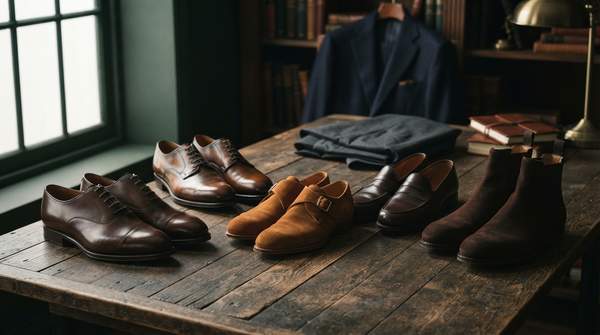
A versatile dress shoe wardrobe comes down to five styles: the Oxford, the Derby, the Monk Strap, the Loafer, and the Chelsea Boot. What separates them isn't price or brand — it's construction. A shoe's lacing system, closure, and sole determine where it sits on the formality spectrum, and that position tells you exactly when to wear it.
The hierarchy is consistent across style guides: the closed-lacing Oxford is the most formal, the open-laced Derby is the versatile professional, the buckled Monk Strap adds flair between the two, the slip-on Loafer rules smart-casual, and the Chelsea Boot fills the smart-casual-to-cold-weather gap. Learn the underlying rules and you can decode any shoe in your closet — or any store window.
The Foundation: Understanding Dress Shoe Formality
Before choosing a shoe, understand what makes it formal or casual. As the shoemaker John White's formality guide puts it, the formality of men's shoes "decreases with added detail and more casual construction." That single principle explains nearly everything about how dress shoes are ranked.
Start with lacing. An Oxford is defined by its closed lacing system: the facing — the two panels where the laces attach — is stitched under the vamp, so the shoe closes firmly around the foot. That closed construction creates a sleek, unbroken silhouette, which is why the Oxford sits at the top of the formality scale. A Derby inverts this: the quarters are stitched on top of the vamp. This open lacing system makes the Derby slightly less formal and more robust in appearance, but also roomier and easier to fit.
Then there's ornamentation. Brogueing — the decorative punched holes found on country-style shoes — always makes a shoe less formal, which is why John White's guide warns it keeps you from "turning up to a black-tie dinner in a brogue." The more detail added, the further down the spectrum a shoe slides.
The sole matters too. John White's ranking addresses this directly: "A slim, sleek sole is more formal than a thick, heavy, or commando-style rubber sole." The same uppers can read very differently on top of a slim leather sole versus a chunky rubber one. Finally, closure type sets the ceiling: a slip-on Loafer, by its very nature, is inherently more relaxed than a lace-up, and is not appropriate for black tie or very traditional business dress codes.
Essential Dress Shoes: Construction, Formality, and Occasions
With the rules in hand, the five essentials slot into a clear hierarchy. The table below classifies each style by its defining construction, places it on the formality spectrum, and maps it to the occasions and garments it serves best. Read down the formality column and you'll see the pattern: every step down in formality corresponds to a step toward more casual construction — from closed lacing, to open lacing, to buckles, to slip-ons, to elastic-sided boots.
| Shoe Style | Defining Feature (Construction) | Formality Level | Best For (Occasions/Outfits) |
|---|---|---|---|
| Oxford | Closed lacing: facing stitched under the vamp, creating a sleek, unbroken silhouette | Most formal — the top of the dress-shoe formality scale | Suits and formal occasions; a plain-toe in polished black is the black-tie shoe, a cap-toe in black covers every formal occasion below it |
| Derby | Open lacing: quarters stitched on top of the vamp, giving a wider opening | Slightly less formal and more robust in appearance than an Oxford | Business casual and smart wear; at home with a suit but also pairs effortlessly with chinos or flannel trousers |
| Monk Strap | Laceless, secured by one or two buckles instead of laces | Sits between the Oxford and Derby, adding flair; the buckle count subtly influences perceived formality | Suits and smart-casual wear; leans toward a more formal, distinctive style |
| Loafer | Pure slip-on, no fastening; comes in tassel, penny, and horsebit styles | King of smart-casual; inherently more relaxed than a lace-up | Casual and professional settings; can be dressed up or down — but not for black tie or very traditional business dress codes |
| Chelsea Boot | Laceless ankle boot with elastic side panels | Smart-casual, with practicality for colder or wetter weather | A logical expansion for a smart-casual wardrobe, adding rugged elegance when suits aren't a daily requirement |
Two boundaries in this hierarchy deserve emphasis. First, the Derby's versatility has a ceiling: while a dark brown or black Derby works with a suit, John White's formality ranking treats it as the business-casual workhorse rather than a black-tie option. Second, the Loafer's relaxed nature is structural, not stylistic — its slip-on construction alone, per the same ranking, makes it inappropriate for formal events like black tie. The Hockerty dress shoe guide draws the same line between the buckled Monk Strap and the slip-on Loafer: the Monk Strap "lean[s] towards a more formal, distinctive style, whereas Loafers offer casual comfort and versatility."