What separates a compelling travel photograph from a casual snapshot is rarely the camera—it is composition. As Dunja Đuđić Kalinin, writing for DIY Photography, puts it, travel photography composition is "what transforms your photos from casual snapshots into narratives that convey the essence of the place you've visited." The good news for a traveler planning a trip is that the core techniques are few, learnable, and each serves a distinct creative purpose. The real skill is not memorizing rules but choosing the right one for the scene in front of you.
Fundamental Composition Techniques for Travel Photography
The rule of thirds is the natural starting point. Mentally divide your frame into a 3x3 grid and place your subject along the lines or at their intersections, rather than dead center. REI's expert advice column notes this creates "a more balanced and visually interesting picture," and many cameras can display a grid overlay in the viewfinder or on the LCD to make this effortless. Neil Long, an architectural and industrial photographer, describes it as one of the simplest and most effective techniques for finding balance and interest.
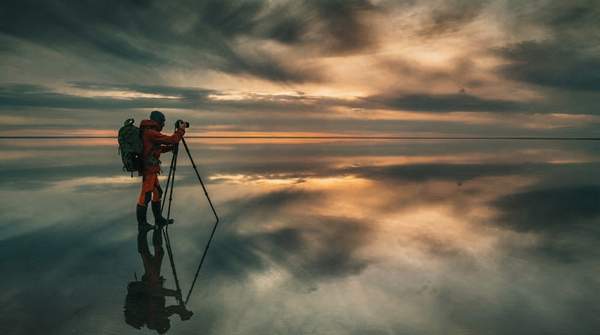
Symmetry takes balance to its logical extreme. Belinda Shi, a travel and portrait photographer, calls symmetry "unarguably balanced" and describes using it extensively in her landscape work by incorporating reflections—whether top-to-bottom or left-to-right mirroring. Jeremy Flint, writing for Digital Photography School, frames it as a way to shoot familiar subjects differently: find a point of reflection and mirror half the image across the composition.
Leading lines and framing add depth and direction. Long illustrates leading lines with a Porto roadway and tramline that pull the eye across the Ponte Luis I toward a tram entering the scene. He describes framing as using elements within the scene—an archway, a window, tree branches—to surround your subject, adding depth and context. Flint suggests looking for frames everywhere when photographing buildings: a structure can frame itself, or be framed by trees, bridges, or car windows. Finally, central placement—deliberately breaking the thirds rule—puts your subject dead center so the viewer is instantly drawn to it and immediately understands the image's theme.
Your Travel Photography Composition Decision Framework
These techniques are not interchangeable; each answers a different creative question. The matrix below matches the goal you have for an image to the technique best suited to deliver it, based on the visual elements your scene offers. Use it as a first instinct in the field—then let your own eye take over.
| Creative Goal | Recommended Technique | Best for Scenes With... |
|---|---|---|
| Create balance and visual interest | Rule of thirds | Almost any subject; a strong single focal point you can place off-center along gridlines or their intersections |
| Establish harmony, order, or reflection | Symmetry | Reflections in water, mirrored architecture, or any naturally repeating structure |
| Guide the viewer's eye and add depth | Leading lines | Roads, tramlines, bridges, pathways, or shorelines that run through the frame toward your subject |
| Add depth and context | Framing | Archways, windows, tree branches, or one building visible through another |
| Deliver immediate, powerful impact | Central placement | A single, dominant subject where you want instant attention and zero distraction |
The framework is a guide, not a law. Brian Brown, a travel and street photographer, is explicit that these techniques "are only suggestions that can be useful if you're feeling stuck," and that "there's no right way to frame a photo—it all depends on your vision and intention for each image." Treat the matrix as your starting point when a scene leaves you unsure, and depart from it whenever your intent says otherwise.
Combining Composition Techniques for Complex Images
The techniques above are often taught separately, but they are not mutually exclusive—and layering them is where snapshots become stories. Flint offers a concrete, evidence-based example: begin with a centrally placed subject, which draws instant attention and makes the image's theme immediately clear. Then, he suggests, "combine some leading lines with your centrally positioned subject to add perspective, dynamism, and energy."
His worked example is a road leading to a car or mountain positioned in the middle of the frame. Notice what each layer contributes: the central placement guarantees the viewer lands on the subject first and reads the story without distraction, while the leading line of the road adds depth and a sense of journey—pulling the eye into and through the image rather than letting it rest flatly on the subject. One technique handles emphasis; the other handles motion and dimension.
You can build similar combinations from the framework. A symmetrical reflection works beautifully with rule-of-thirds placement of the horizon line along a gridline; a framed archway gains further depth when something within it—a figure, a doorway—sits centrally. The practical method is to ask the matrix two questions in sequence: what do I want the viewer to feel, and which second technique can amplify that feeling without competing with the first?
Transforming Snapshots into Stories: Your Next Steps
Actively apply at least one composition technique to every travel photograph you take, consciously choosing it based on your scene and desired visual effect. Before your trip, enable your camera's grid overlay so the rule of thirds is always visible; in the field, run through the framework—balance, harmony, depth, direction, impact—and pick the technique that matches your intention for that frame.
One boundary worth naming: this is a guide to composition alone. It does not cover camera settings like aperture, shutter speed, or ISO, and it is not a guide to photo editing or post-processing—those are separate skills for another day. It is also not an exhaustive catalog of every compositional rule.
The measurable indicator of progress is noticeable improvement in the visual impact and storytelling quality of your travel photo collection over time. Review your images after each day of shooting and ask one question of each frame: which technique did I choose, and did it deliver the effect I intended? That habit—deliberate choice, then honest review—is what turns a folder of snapshots into a narrative of the places you have been.
Sources
- Storytelling Through Travel Photography: From Snapshot to Narrative — DIY Photography
- Photo Composition: Seven Tips to Take Better Photos — REI
- Mastering Composition Techniques for Mind-Blowing Travel Photography — Architectural & Industrial Photography Neil Shelby Long
- 6 Proven composition Tips For Unique Travel Photos | Belinda Shi Photography
- 12 Travel Photography Composition Tips (to Instantly Improve Your Shots!) — Digital Photography School
- Composition Techniques for Travel Photography — Brian Brown Film