The best camping headlamp is rarely the brightest one on the shelf. Independent testers who measure real output with industrial light meters, like the team at GearLab, consistently find that the right pick depends on what you actually do after dark—reading in a tent, cooking at camp, or hiking a trail at night. This article gives you a decision framework for evaluating any headlamp against your own activities, so you spend on the features you'll use and skip the ones you won't. It covers headlamps only, not lanterns, and it evaluates features rather than naming a "best" model.
Understanding the Core: Lumens, Beam Patterns, and Battery Life
Three specifications do most of the work in any headlamp decision, and they pull against each other. Lumens measure total light output. Beam pattern determines where that light goes: a floodlight spreads light evenly across a wide, close area, while a spotlight concentrates it into a narrow column that reaches far down the trail. Battery life is the third leg, and it is where brightness exacts its price.
The interaction is stark, and published test data makes it concrete. Treeline Review, whose team has logged hundreds of nights of headlamp testing, measured one popular model (the Petzl Tikkina) at 2.5 hours of runtime at its 300-lumen maximum, 9 hours at 100 lumens, and 100 hours at 6 lumens. That is a forty-fold difference in runtime between the same lamp's highest and lowest settings. In other words, a headlamp's advertised maximum tells you almost nothing about how it will perform on the setting you use most.
Battery type compounds the trade-off. Testers at 1Lumen.com, who run runtime tests across dozens of models, advise that headlamps built around larger rechargeable cells—an 18650 or 21700 battery—sustain both higher output and longer runtimes than the common three-AAA designs. If your trips run long or you camp far from a charger, cell capacity matters as much as the lumen number on the box.
The Power of Red Light: Preserving Night Vision and More
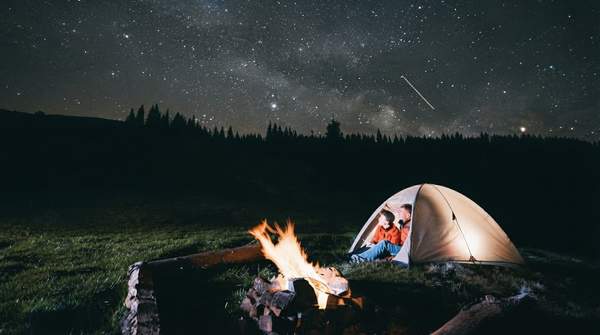
Many headlamps include a red-light mode, and it earns its place in specific situations rather than everywhere. The classic use is preserving night vision: your eyes adapt to darkness over time, and a burst of white light resets that adaptation, leaving you fumbling for minutes afterward. A dim red glow lets you check a map, find a water bottle, or step out of a tent without blinding yourself—or your tentmate.
That makes red light most valuable for campers who share a tent, stargaze, or move around a sleeping campsite. For active tasks like cooking or hiking, it adds little; white light does those jobs better. Treat red mode as a tiebreaker between two otherwise equal lamps, not as a substitute for getting beam pattern and battery life right. A lamp with a great red mode but the wrong beam for your main activity is still the wrong lamp.